Chaos. Wrenching at her. It will sweep her away if it can. Clari’s left hand grips the gummy steering wheel, her right the stubborn gear stick. Catapulting her way through Manila traffic, she jostles for position with this gargantuan herd of metallic water buffalo. The old SUV’s air-conditioning battles the city’s fume-ridden oven heat; Clari’s brow drips liquid salt into her eyes. She wipes away the worst, then swipes hard at the car horn. A young woman is striding across the road in front of her. This is routine pedestrian behaviour; ignoring everyone on wheels, presuming they will slow down or swerve around. When a pedestrian, Clari herself adopts the same strategy of nonchalance, though with less bravado than this Filipina, who, now that she is safely across, acknowledges Clari’s existence with a look of mild annoyance.
Sounding her horn has simply exposed Clari’s identity as a foreigner: out of sync and so completely in the wrong gear. All cultural readjustment skills have apparently abandoned her. She is straining to see the kaleidoscope frenzy of heat-shimmering streets, vehicles, humanity with the eyes that once welcomed these sights as friendly, familiar, even appealing. Exhaling sharply, she gasps a prayer: a single, “Help,” with a single tear mingling its saltiness with the sweat on her cheek.
Anguish is the currency for leaving. And returning. The first few days back are an inevitable pit of teeth grinding, disorientating, limbo-like lostness. She will find her feet again, and all will be well. Only not quite yet.
Now she is fighting a rising desperation to reach the NGO headquarters before she crumbles. Simply being on site with colleagues, with the kids, will rebalance her emotions, reset her being. And remind her why she first came to this country, why she keeps coming back.
#
Tap, tap, tap.
Her son’s fingers on the glass garden table, drumming his disapproval. Clari is making a last-ditch attempt to relish the fresh brightness of a Devon spring. They sit together out on the cobbled terrace amidst the grandeur of Eddie and Susan’s immaculate shrubbery. To no avail. He cannot keep silent.
“Mother, don’t you think…” Eddie shifts uncomfortably in his bamboo chair. “Well, don’t you think that…”
He seems exasperated at his loss for words, but his mother is not about to help him out. She gazes at him with mixture of love, patience, a touch of sadness.
“It’s just that, at your age,” Eddie persists, “don’t you want to be thinking about, well, preparing for retirement? Here. In England.”
Clari’s smile only serves to frustrate him further.
“Instead of gallivanting, mother, around the world. And always back to the Philippines! Of all places!”
“Of all places, Eddie, the Philippines is a pretty darned good place to gallivant!”
Clari immediately regrets her half-hearted attempt at humour. Her dear, handsome son’s face twists momentarily; that furrowed brow, that pursing of lips, a sharp reminder of his childhood expression of disappointment.
#
Tap, tap, tap.
Clari has stopped at a red light. A scrawny boy of around eight years old is reaching up to her window and knocking, his other hand shading his eyes so he can peer through the tinted glass of her aircon bubble and make eye contact.
His arms are spindle thin. Dried snot streaked across his face from nose to ear, edged black, as are all his features, with the soot and grime belched from a thousand exhaust pipes.
He cups one hand.
“Ma’am, ma’am,” his voice barely makes it through the locked steel and glass.
Clari instinctively gives one sharp tap back on the window. The understood signal, the definitive ‘NO’.
The boy is gone in an instant. But not before imprinting on her, as a lightning slash, that automaton expression of despondency.
Clari groans, and wills the red to green so she can flee the scene.
It has her, the partially irrational, wholly familiar fury. Furious with the lost boys. Furious with herself. Furious with the systems that keep these little ones enslaved.
Finally green to go. But she needs to take this fury with her, not leave it behind.
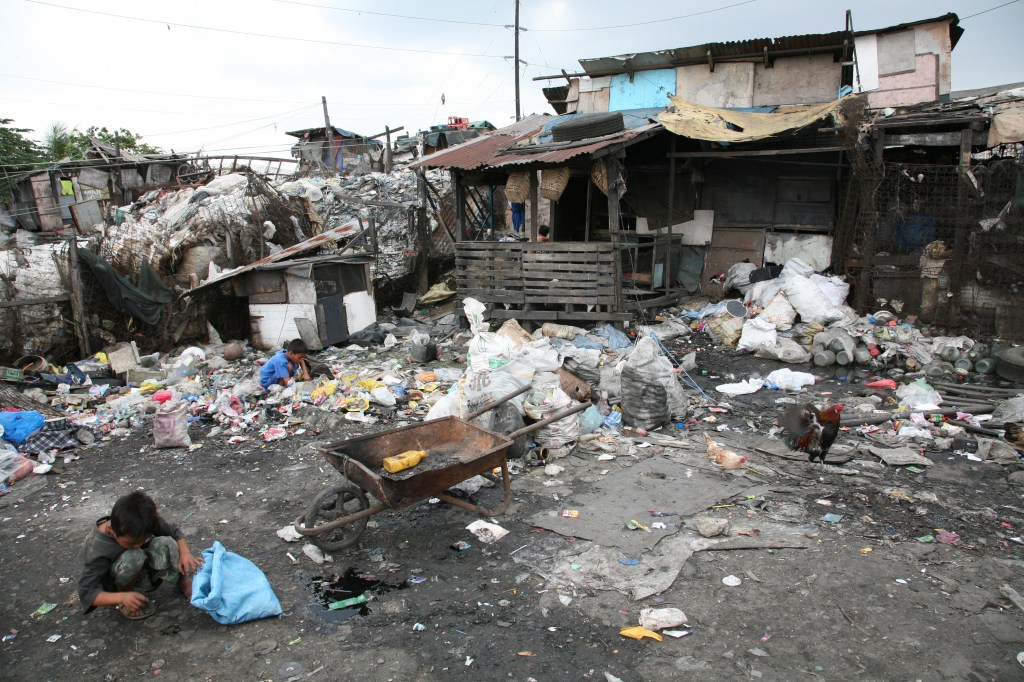
A few hours later Clari is squelching her way over Tondo’s garbage dump with Gail, her colleague. A torrential downpour has turned the ground into a dark toxic mix of degraded waste, redeemed only by a random smatter of genuine mud. The atmosphere is heavy with the humidity of overlapping hot and rainy seasons. It is a sauna laced with the stench of decay. Fat flies atop every millimeter of wire, alongside and crisscrossing overhead the alleyways.
They follow a zigzagging path among the hundreds of shacks crammed together in this startlingly vibrant community. In the midst of squalour, Clari also knows the embrace of gracious welcome.
She finds herself enacting a manic form of breaststroke: First, and for most of the time, head up, catching people’s eyes, returning their smiles and greetings; then for an instant, head ducked and eyes lowered as she wrestles away the clashing of senses. Clari does everything to hide those moments, lest misery expose misery.
But who’s fooling anyone, she murmurs.
Gail reaches out to steady Clari’s arm as they step gingerly, one after the other, on a slimy plank bridging a narrow ditch of grey bubbling goo. Clari sees in her friend’s face a steadiness, a warmth that make her grin back with gratitude. Whether Gail understands an Englishwoman’s state of shellshock, it matters not, at this moment.
They are on their way to visit one of the sponsored students, and once they have located the right dwelling, Gail goes in alone to talk with the mother. Clari does not want her presence as a foreigner to complicate the situation; Gail needs to get to the bottom of a delicate matter with the parents. The signs are that their ten-year-old son has dropped out of school because of bullying, but, so far, neither the boy nor the parents have been willing to talk about it.
Clari finds a rough bench made of scrap wood. She hopes it will hold her weight, but she will risk it; it is too tempting to resist, situated as it is in an oasis of shadow. The moment she is sitting two children join her. The little girl jumps up to sit next to her, an even younger boy, even more raggedly dressed, stands shyly close by.
“Whats-sha-name?” asks the girl, grinning from ear to ear, her grime smudged nose wrinkled and her eyes dancing with an urgent curiosity.
“Ako si Clari. Ikaw, ate, anong pangalan mo?” Clari replies in Tagalog. I’m Clari, little sister, what’s your name?
“Grace, po.” Grace, ma’am.
“Ikaw, kuya?” Clari turns to the little boy who is edging even closer to them.
“Darren, po,” his voice is husky, Clari guesses it is from the acrid air of the nearby charcoal burning area.
Clari returns to simple English to find out if they are brother and sister. But they are not related. Grace tells her that Darren was a neighbour. But now “walang tatay, walang nanay”. No papa, no mama. So, he is living with Grace and her mother, her father, and three brothers.
One little extra body to squeeze in when they lay out their sleeping mats at night.
Clari pats her lap. “Let’s sing, Darren!” The little ragamuffin of a boy lets out a croak of excitement and leaps up, all shyness evaporating. Clari is now determined that, as soon as Gail reappears, she will ask for her help to find out from Grace’s parents if Grace and Darren are both going to school. If not, they will be invited to apply for student sponsorship. In the meantime, let the singing begin.
Clari is about to launch into her favourite children’s action song, Ikot, ikot, ikot (‘Turning, turning, turning’)when she feels a:
Tap, tap, tap.
Darren has just discovered her phone: he is knocking on the pocket of her jeans.
“Pitchure-pleese, po!”
With both Grace and Darren now on her lap, with one arm she holds them close, her other arm stretched up and out for a glorious selfie. The three crane their necks forward, all in one joyous accord, smiling triumphantly upwards as if to say,
For this moment
we belong
together.
And, anchored by these children, Clari’s heart aches a little less.
Something I read recently caught me by surprise. It was something mentioned in passing, ‘tucked away’ in a much bigger message about a completely different subject. But, in that moment of reading, it was like catching sight of a hidden gem. Here it is:
“You were well aware that the reason I ended up preaching to you was that I was physically broken, and so, prevented from continuing my journey, I was forced to stop with you. That is how I came to preach to you.”
Paul’s writing to the folks in Galatia, in modern-day Turkey, and reminding them how their community first began. (Galatians 4:13; The Message)
It struck me that the amazing stuff which was to happen afterwards, in a way all started with the messy reality of Paul’s physical limitations.
This is a particularly encouraging thought for me today as I reflect on how life tends to confront us with our own limitations. But here’s the thing: these limitations don’t disqualify us from God’s love. In fact, I have a hunch they make us even more eligible –
for divine love,
for how God would bless others through us,
for new resources of hope, wisdom, especially of courage.
We don’t have to wait for the moment (the Inevitable Never) when we’re completely ‘fit for service’, or as if God’s love was something we first needed to deserve.
After all, love’s moment is now.
Unpromising, difficult circumstances are sometimes the fertile ground for rich blessings. Seeds of good(even great)-things-to-come can be planted in our limitations, germinated in our very brokenness.
We’re not disqualified by our frailty.
What challenges are you facing?
Can acknowledging the reality of our limitations, weakness, brokenness, actually open up the way to receiving God’s grace, strength, courage and LOVE?
Several years ago, my Dutch nephew, who lives in the U.K and was studying theology at the time, recommended a book by a Filipino pastor. Intrigued by the title, as well as the route of the recommendation, I got hold of a copy and read it.
‘It’s OK to be Not OK: The Message of the Lament Psalms’ by Federico (Rico) G. Villanueva is a gem of a book! First published, I think, around 9 years ago, it paved the way, gave us permission perhaps, for Filipino and Dutch and British Christians alike, to be a little bit more honest and a little bit less ‘happy-clappy’.
The main message I remember from that book is about how, at certain points in our individual and collective lives, lamenting is not an optional extra.
In some situations, it’s the only legitimate next step.
By the way, lamenting is not just an ‘Old Testament thing’. Jesus lamented over Jerusalem, over the death of his friend Lazarus, in the garden of Gethsemane, on the Cross…
To lament means, for example, to weep, wail, complain, grieve, howl, moan, cry out.
>> How do we lament?
Very recently, our own pastor in the Philippines talked about ‘The Language of Lament’.
You can watch it here:
“You’re given permission to sit in your pain and sulk in it and think about how you felt,” he says.
Also collectively, as a community, as a society: “There’s a way lamenting can actually lead to social change.”
Lamenting is sometimes the only appropriate response to a reality check.
And the only way to move forward:
to joy, to love, to forgiveness, freedom,
to action.
As Pastor Bebs asks:
>> Have we given ourselves the chance to lament?
>> Have we given ourselves permission to use robust language to express what we felt when our world fell apart?
>> It’s not meant to be a permanent exercise, but have we ever gone through the few moments just to admit that something actually hurt? And in that admission, that it would fester less, that we would be able to release it and find healing.
NB. Related to the subjects of collective reality checks and lament, two articles:
Easter 2021 feels like an Easter as no other, doesn’t it? Yes, this time last year we were also in a pandemic, but today I think we are in a very different place than Easter 2020. I don’t mean physically, though that, for some of us, has been precisely the main point of anguish: physically stuck in the same place. I mean we’re in ‘a different place’ in the sense of everything we’ve been through – mentally, emotionally and spiritually – over the last year.
So, here are a few hope reflections for Easter 2021:
1. Hope vs. fear
The first is a point from Matt Krick’s ‘Theology of Ecology’ on how Jesus uses the natural world to tell us not to worry. In the Gospel of Matthew Jesus says:
“Look at the birds, free and unfettered, not tied down to a job description, careless in the care of God. And you count far more to him than birds.”
“If God gives such attention to the appearance of wildflowers—most of which are never even seen—don’t you think he’ll attend to you, take pride in you, do his best for you?”
(Matthew 6:26 & 30 The Message)
Consider the birds, consider the flowers. Can they teach us something? Can we let God use them to lead us out of any worried or anxious state we may be in – into hope?
2. Hope: I am seen, I am loved
If you have a moment, watch Station 13 from the online series ‘The Stations of the Cross and Table’. It’s about how Mary is the one who is first to witness Jesus’ resurrection. Here it is:
Easter is about the Cross. And what it means. Consider the love God has for us. Let it sink in deeper than perhaps we’ve ever let it sink in before…
3. Hope: our future
Easter is also about Resurrection Sunday, and the mind-blowing ultimate hope we have because of Jesus: death does NOT have the last word. Trying to describe how resurrection will work in each of our lives, Paul writes (also using the natural world):
“We do have a parallel experience in gardening. You plant a ‘dead’ seed; soon there is a flourishing plant. There is no visual likeness between seed and plant. You could never guess what a tomato would look like by looking at a tomato seed. What we plant in the soil and what grows out of it don’t look anything alike…”
“You will notice that the variety of bodies is stunning. Just as there are different kinds of seeds, there are different kinds of bodies—humans, animals, birds, fish—each unprecedented in its form. You get a hint at the diversity of resurrection glory by looking at the diversity of bodies not only on earth but in the skies—sun, moon, stars—all these varieties of beauty and brightness. And we’re only looking at pre-resurrection ‘seeds’—who can imagine what the resurrection ‘plants’ will be like!”
(1 Corinthians 15:35-41 The Message)
Consider the ‘seed versus plant’ idea and what this may be hinting at about the differences between our pre- and post-resurrection selves?
Consider the diversity of beauty we see on this planet, in the skies, in the universe and the clues this may be giving us about the future “diversity of resurrection glory”.
My mother’s phone call had just brought the news: My father had suffered a severe heart attack and was in hospital recovering. Emergency over, my mother had reassured me. Despite my repeated offers to come over, she insisted there was no need to make the trip from Amsterdam to Newcastle. It would be a waste of time.
But that had always been my mother: no fuss, no bother, no worries. Once I had told my son, Joshua, about his grandfather, he said, “It’s your father! Go!”
For a moment I was motionless and speechless with received revelation.
Then, “Josh, yes! You’re right!”
I was off like a racehorse, unboxed from my uncertainty. Riderless, free.
The following week was spent accompanying my mother on daily trips to the hospital to visit my father. I had never had a week like it. He was a changed man. The wall around his soul, which had been there my entire life, was gone. Our separation evaporated. There in that ward we talked as we had never talked before. At the age of 42, I finally recognized something of myself – not in my mother, but in my father – for the first time.
The day after I returned home to the Netherlands, my mother phoned.
“He’s gone.”
And through grief and shock rose gratefulness for the intervention of a thirteen-year-old.
New York’s experience may well be a warning to us all – of what is to come in our different parts of the world: The pandemic is the ‘Great Exposer’ of the grim reality of our inequalities…
Currently journalists have the crucial role of doing what good writers always do: they stop us in our tracks with truth we instinctively already know, but hadn’t been able to quite put into words.
And then you have the specialists, the academics, who are also writers. How we need them now! They tell us truths we may have already guessed at (or have no clue about), but their words expose the dark undercurrents. Their words solidify the abstract into living prophesies.
As societies, we ignore them at our peril.
For example, there is Kent Sepkowitz, an infectious-disease specialist in New York City. He writes a powerful article on why his city has been hit so hard by COVID-19, and finishes with these words:
“Hopefully, the Covid-19 pandemic will force us to reckon honestly with the many shortfalls that have been exposed and build a fair, forward-thinking approach that allows doctors and nurses to care for people in need. Failure to do this will only further darken the memory of those who have died and the hearts of those who remain.”

 CrackedCeiling